You are here: Screening Information > Public > Frequently Asked Questions
 

Frequently Asked Questions


About screening for your baby

About delivering a high quality service

Use of stored newborn blood spots

Why is screening important?

Newborn blood spot screening identifies babies who may have rare but serious conditions. Most babies screened will not have any of the conditions but, for the small numbers who do, the benefits of screening are enormous. Early treatment can improve their health and prevent severe disability.

What are newborn babies screened for?

In the UK all babies are screened for phenylketonuria (PKU) and congenital hypothyroidism (CHT). In some areas babies are also screened for cystic fibrosis, sickle cell disorders and some other conditions. If you want to know which conditions are screened for in your area, please ask your midwife.

Do I have to have my baby screened?

Screening your baby for all these conditions is strongly recommended, but it is not compulsory. If you do not want your baby screened for any or all of these conditions, discuss it with your midwife. All your decisions will be recorded in your notes.

If you think your baby might not have been screened, speak to your midwife or GP.

How many babies are screened every year?

Every baby in the UK is offered newborn blood spot screening. Over 800,000 babies are born in the UK each year.

Do we have to pay to have our baby screened?

No. The National Health Service (NHS) covers the cost of screening newborns for these conditions.

When will my baby be tested for these conditions?

Your midwife will take some drops of blood from your baby’s heel about 5-8 days after the birth.

How can I help my baby cope with the heel prick?

You can make sure your baby is warm and comfortable and be ready to feed and/or cuddle your baby immediately after the sample has been taken.

Why does the blood have to be taken from babies when they are only a week old?

Screening is done at slightly different ages in different countries. In some countries the heel prick is done earlier because there are no community midwifery services to test the baby at home and there would be a risk of babies being untested after discharge from hospital. In the UK the test is done at about a week of age. This is considered the best time to test for all the conditions together because it allows for getting the results back with time to do diagnostic tests and start treatment early. If babies were tested later, the outcome for some of the conditions would not be so good. Siblings of children affected by one of the conditions can be tested earlier but in general the 5-8 day ‘window’ is best as the disorders are detected more reliably during this period with the lowest chance of needing to repeat the blood test because of borderline or incorrect results.

When is a second sample necessary?

Occasionally the midwife or health visitor will contact you and ask to take a second blood sample from your baby’s heel. This may be because there was not enough blood collected, or the result was borderline or unclear. Usually the repeat results are normal.

Why don’t you test for these conditions during pregnancy?

In the UK, we do not test for phenylketonuria (PKU) or congenital hypothyroidism (CHT) in fetuses during pregnancy. Sickle cell disorders are screened for during pregnancy. It is possible to screen for cystic fibrosis in pregnancy, but currently this is not done in the UK.

I never received the results from when my baby was screened – should I be worried?

Very few babies are found to have any of the conditions screened for by routine blood spot screening. In some areas it is still not routine for results to be given to parents and this is something the Programme Centre are striving to change. Although it is extremely unlikely that there is cause for concern it is not advisable to assume that ‘no news is good news’. If you have not received the results of your baby’s screening test, you should ask your health visitor or GP to check your baby’s health record and record the results in your baby’s personal child health record. Results are usually available by the baby’s 6-8 week health check.

What do ‘positive result’ and ‘negative result’ mean?

A positive screening result suggests that it is more likely that a child has one of the screened conditions. For example, if a baby screens positive for PKU, it means that he or she is very likely, or is presumed to have PKU. A positive screening result indicates that further diagnostic tests are needed to confirm whether or not the child is affected. We cannot say whether a child is affected by the condition until these tests are undertaken and the result confirmed.

A negative screening result suggests that it is unlikely that the child has any of the screened conditions. Under these circumstances further diagnostic tests are not needed.

It is important to remember that screening is not 100% certain and a child with a negative screening result may later turn out to have the condition, while conversely, a child with a positive result may turn out not to have it.

What is a carrier?

Everyone inherits two copies of each gene in their body – one from their father and one from their mother. One or both copies of a gene may have a change (mutation) that alters the function of the gene. A carrier is someone who has only one copy of a changed (mutated) gene in a gene pair. In certain cases mutations only cause disease if both genes have the mutation (autosomal recessive conditions). Carriers of these mutations therefore have no symptoms of disease and are often referred to as 'healthy carriers'. The carrier can pass on the altered gene to their offspring. If a person inherits an altered gene from both parents then they will have the disorder. This is the case with three of the conditions tested for in newborn screening: cystic fibrosis, sickle cell disorders and phenylketonuria (PKU). Carriers are also referred to as heterozygotes, because they carry two different versions of the same gene.

Carrier status is very common. In northern European populations, for example, about 1 in 20 people carry a cystic fibrosis (CF) gene, but newborn screening will only identify some of these carriers because the gene is only tested in babies who also have a biochemical abnormality detected by the screening test. Babies who are found to be carriers of CF may need further testing to determine whether they are carriers (and therefore unaffected by the condition), or whether they do actually have a second mutation and therefore are likely to be affected.

Currently, the technology used to test for sickle cell disorders in newborn babies identifies the majority of babies who are carriers. In some African groups as many as 1 in 7 people carry a sickle cell gene and newborn screening will find the majority of carriers by identifying some sickle haemoglobin (the oxygen-carrying substance in red blood cells).

For phenylketonuria (PKU), the test is based on finding high levels of the amino acid phenylalanine (one of the building blocks found in protein foods) in the blood and carriers don’t seem to have abnormal amounts of this, so they are not found through screening.

In all cases, if a previous child has not been found to be a carrier or affected by one of the conditions, it doesn’t mean that the next baby doesn’t need testing.

I have been told that my baby is a carrier. What does this mean for my baby and my family?

Carrier status is very common and is not associated with ill health.

For your baby:

  • If your baby is a carrier, then he or she will be healthy

  • Sometimes further tests are needed to confirm CF carrier status and you can arrange these through your GP (Carrier of cystic fibrosis gene leaflet)

  • Sickle cell carrier results from newborn screening are usually more straightforward, but your midwife or GP will tell you if further tests have been recommended and can arrange these.

For your family:

  • A baby may be a carrier because one of their parents is. This is quite common and of no particular concern, as we all carry altered genes.

  • Rarely, a baby may be a carrier because both their parents are, but they have inherited the changed gene from only one. If both parents are carriers there is a 1 in 4 chance that a future brother or sister born to the same parents may inherit both changed genes. In this case the baby would have CF or a sickle cell disorder. Currently, mothers are offered testing for sickle cell in pregnancy, so mothers who are carriers should know they are. However, if in doubt, a genetic counsellor can explain this in more detail and arrange for any tests for you if you are concerned.

As a parent, how can I get involved?

We believe that parents' views and experiences should be central to the work of the Programme Centre. We aim to achieve this in two ways:

  • Learning about parents' views and experience of newborn blood spot screening from well-conducted research.

  • Inviting parents to draw on their views and experiences of newborn blood spot screening to guide our work at various stages, including commenting on leaflets.

If you are interested in using your experience of newborn blood spot screening to guide our work then we'd like to hear from you. Please contact us at Emma.Scott@gosh.nhs.uk for further information.

Where can I obtain copies of the pre-screening leaflet?

We recommend that parents are told about newborn blood spot screening during the third trimester and provided with a copy of the national pre-screening leaflet. Their midwife should confirm which conditions are screened for in their area.

After birth, at least 24 hours before taking the heel prick, their midwife should check parents have a copy of the national pre-screening leaflet and discuss newborn blood spot screening with them. The leaflet is available to download and print from this website under ‘Resources’ and you may photocopy it as needed.

Will the leaflets be available in other languages?

Yes, the leaflet 'Newborn Blood Spot Screening for Your Baby'  is available in 18 languages. Electronic copies are available here.

Must babies have a certain number of days of milk feeds before screening takes place to ensure accuracy of the test?

No, there is no need to wait. The Programme Centre has concluded that there is no need to wait for a baby to be on milk feeds prior to newborn blood spot screening. In the past, confusion has existed around the need to wait until a baby has had sufficient milk feeds to ensure accuracy of the PKU screening result. Research suggests that this is an unnecessary delay, as milk feeds do not significantly alter the screening result. Delaying can increase the risk of screening not being carried out on that particular baby.

If babies heels are pricked between days 5 and 8, how is this calculated?

The Programme Centre recommends that the calendar day on which a baby is born is considered day 0, no matter what time of the day the baby is born. The day after the baby’s birth date is therefore day 1, and so on to days 5-8. This is easy for everyone to understand and follow.

When should premature babies be screened?

Babies who are premature, unwell, or have had blood transfusions should all have the newborn blood sample taken as usual between 5 and 8 days of age AND this information recorded on the blood spot card. If a repeat sample is needed the laboratory will request this. It is very important that the test is taken at the usual age so there is no risk of a baby going untested.

If a family with a baby moves into the area, do health professionals need to check that the baby has had the screening test?

For babies under 1 year of age who have moved into the area and are reported to have been screened, confirmation of testing is required. This may take the form of a faxed or written copy of the results or results in the parent held child health record. Where no proof of testing is available it should be assumed that the baby is untested and re-testing arranged.

What are newborn blood spot cards?

In the UK, all newborn babies are offered screening for a small number of rare conditions.  These include phenylketonuria (PKU), congenital hypothyroidism (CHT), sickle cell disorders (SCD), cystic fibrosis (CF) and Medium Chain Acyl-CoA Dehydrogenase Deficiency (MCADD). The aim of newborn blood spot screening is to identify babies with these conditions early so they can be treated quickly to prevent severe disability or even death. 
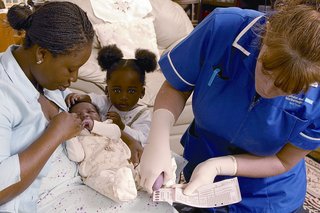
When babies are about a week old, blood is collected from their heel onto a card (see a picture of a blood spot card below) and used for screening tests. These cards also record some personal information including the baby’s name, mother’s name, baby’s date of birth, address, contact details of the GP and midwife, and baby’s NHS number. These are necessary to make sure the results of the screening tests are matched to the right baby. When the screening tests have been completed all cards, including any remaining blood spots not needed for the screening tests, are stored for at least five years. In some parts of the country cards have been stored for longer periods of time.

Newborn blood spot card
(actual size approximately 23cm x 8.5cm)
Newborn blood spot card

Why are blood spot cards stored?

Stored blood spot cards are a unique and valuable health care resource.  Because blood is collected from almost all newborn babies in the UK, the blood spot cards are particularly useful for monitoring the health of the general population.  They are also very useful for research into the health of mothers and babies.

Stored blood spot cards therefore have a number of possible uses. They can benefit both the population as a whole, and individuals and their families. Stored blood spot cards are used in the following ways.

How are the stored blood spot cards used?

  1. To monitor and improve the newborn screening programme
    Newborn screening laboratories use stored blood spot cards to monitor and improve the screening programme. They may use the blood spots to double check the reliability of the screening tests. For example, from time to time they may retest a number of spots to check that the screening tests are working properly. The laboratory may also use stored blood spots to develop and check new methods of testing for the conditions they currently screen for. 

  2. To directly benefit individuals and their families
    Stored cards may be used to directly benefit the family or child.  If a baby has died but the cause is unclear, a doctor may request that the baby’s stored blood spots are tested to try to find the cause of death.  Stored blood spot cards have been used, for example, to find out whether a baby had a genetic condition, which may have caused their death.

    As well as providing valuable information for parents about the cause of death, in some cases testing the stored blood spots may also provide information about the parents’ risk of having another baby with that condition. Sometimes this sort of testing also leads to tests being offered to other family members to find out if they have the same condition.

    Stored blood spot cards might also be used to identify the body of someone who has been killed in a disaster when there is no other way of identifying them. For example stored blood spots have been used in other countries to identify bodies of people killed in a factory fire and those killed by the tsunami in 2004.

  3. To monitor the health of the general population
    Blood spot cards can be used to:
    • answer questions about the health of the general population;
    • provide information for health service planning; and
    • help to measure how well public health policies prevent or manage disease.

    The stored blood spots are particularly valuable because it is sometimes possible to find out information about mothers’ health from their babies’ blood spots.  For example, by testing a baby’s dried blood spot, you can tell whether or not the baby’s mother has human immunodeficiency virus (HIV) infection. Anonymised blood spots (where the blood spot has been separated from any identifying information on the card) have therefore been used since the late 1980s to measure the extent of HIV infection in the general population. Because this programme is anonymous and there are spots for nearly all babies, it gives more accurate estimates than if women are asked directly to give blood for named HIV testing. This programme has had important benefits for mothers and babies.  By testing newborn blood spots and comparing the numbers with diagnosed cases of HIV in pregnant women, it was found that although the number of infected women was steadily increasing, most did not know they had HIV.  This led to a national policy to recommend voluntary antenatal HIV testing to all pregnant women.  Now, 90% of pregnant women agree to named testing, and women with HIV can be offered treatment which reduces the risk of them passing the infection on to the baby from about 1 in 5 to less than 1 in 50.

    The blood spot cards have also been used as part of approved research to find out how many people have a particular genetic condition. This is valuable information to help plan for healthcare services.  For example, in some countries the spots have been used to find out how many people carry genetic mutations causing a condition called primary haemochromatosis. This is an inherited disease. People with primary haemochromatosis absorb too much iron from their food. Although iron is beneficial, if too much iron builds up in the body, as it does for people with haemochromatosis, this can cause liver damage or heart disease.

  4. To answer questions about specific health problems
    Researchers can use stored blood spots to answer research questions about specific health problems. For example, researchers have tested the spots of children who have developed leukaemia later in childhood to see if the genes that might cause it were present when these children were a week old.

    Investigating the natural history of childhood leukaemia
    Stored newborn blood spots have been used to investigate whether genetic markers associated with childhood leukaemia are present at birth. In these studies, stored blood spot cards from children diagnosed with acute lymphoblastic leukaemia have been tested for genetic markers also present in their tumour cells. Since these markers were found on blood spots from the children who developed leukaemia, but not on those of children in the study ‘control’ group, this provides strong evidence that this type of leukaemia originated before the child was born and may have been caused by exposures or gene mutations occurring or arising during pregnancy.

    The blood spot cards of specific groups in the population (e.g. children with particular symptoms or diseases) have been used in research on:

    • maternal infections and the effects of these on children's health; and
    • genetic disorders and environmental factors as possible causes of ill-health

    As an example, blood spots have been used in research on cytomegalovirus (CMV) in children with hearing loss.  CMV can be passed from a pregnant woman to her unborn child.  This virus may result in delayed development or loss of hearing or sight.

    Linkage to other information
    When monitoring the health of the general population or researching the origins of specific health problems, it may be useful to link the blood spot cards to other information.  This might include birth registration or hospital admission records, for example, the NHS Hospital Episode System, which records when individuals are admitted to hospital and their specific diagnosis. If blood spot cards are linked to this additional information, steps are taken to ensure that personal information is protected and that individuals’ identities are kept confidential.  

    Linkage to other records can allow researchers to relate the results of tests done on the stored spots to people’s later health. It is also possible to select spots from children with and without specific diseases and to test them for different markers. For example, researchers can explore whether certain genetic variations might predict a particular disease.

  5. To develop new equipment and tests
    Blood spots are needed when developing new equipment and new tests before they can be used routinely in screening.  It is very important to be able to use the stored blood spots for these purposes so that new advances can be properly checked.  For example, stored spots have been used to develop tests using equipment called a tandem mass spectrometer.  With this equipment it is possible to screen for many more conditions than was possible in the past.  The blood spots have also been tested for research to decide whether or not a screening programme should be introduced for other conditions in the future, such as toxoplasmosis.

    What is toxoplasmosis?
    Toxoplasmosis is caused by a common parasite. Some people who have toxoplasmosis may feel as if they have the "flu" with swollen lymph glands or muscle aches and pains that lasts for a month or more. It can develop from an acute toxoplasma infection or one that had occurred earlier in life and is now reactivated. If a woman is infected with or has reactivation of toxoplasmosis during pregnancy, this can cause severe eye or brain damage in her baby. Most babies who are infected while still in the womb have no symptoms at birth, but they may develop symptoms later in life. It is important to know how common this is to decide whether a screening programme would be appropriate.
  6. For police forensic work
    In certain unusual situations the police can apply for a court order to allow them access to the blood spot cards of specified dead or missing individuals for forensic purposes. This happens very rarely. Current guidance is that samples from specified individuals who are alive and not missing can only be released with a court order for this purpose.  This is because living individuals can provide another sample. 

    The police are only allowed to apply for a court order to access blood spots for specific named persons.  They do not have access to information from stored blood spot collections, and are not allowed to ‘trawl’ through a collection of blood spots in the hope of identifying someone.

What are the current arrangements to protect the interests of the public and keep personal information private?

There are a number of ways in which the interests of the public and personal information are protected.  These include regulations and laws governing the storage and use of blood spot cards, parental consent and assurance of anonymity and confidentiality.  Each of these is explained in more detail below.

Regulations and laws governing the storage and use of blood spot cards
The storage and use of newborn blood spot cards is regulated in a number of ways, including through a Code of Practice, laws, ethics committees and scientific peer review. Strict guidance exists about who is allowed to access these blood spot cards and how the cards can be used. 

  • Code of Practice
    The UK Newborn Screening Programme Centre has developed a Code of Practice to govern the storage and use of newborn blood spot cards.  Under the Code of Practice, it is recommended that the cards are stored for at least 5 years for quality assurance purposes related directly to the screening programme. Cards may be stored beyond this initial 5 years for a number of potential uses, discussed in the section above.  The laboratory directors are ‘custodians’ of the cards, storing them, and ensuring guidelines about their use are followed.
  • Laws
    Laws covering the use of the cards include the Data Protection Act 1998, the Health and Social Care Act 2001 and the Human Tissue Act 2006. The specific guidance relating to the management of blood spot cards has been developed with careful reference to these laws.
  • Ethical approval and scientific peer review
    Stored blood spot cards can only be used in research if they have approval from a Research Ethics Committee (a committee that considers the ethical issues raised by the research).  All potential research projects must also be reviewed by other scientists.  These scientists judge the scientific value of the research before a project can be approved. This process is known as ‘scientific peer review’. 

Parental consent
When parents are offered newborn blood spot screening for their baby, they are provided with a pre-screening leaflet and have a discussion with their midwife.  This is to help them to make an informed choice about screening. Parents are asked to consent to screening.  The pre-screening leaflet also contains information about the storage and use of blood spot cards after screening tests have been completed.

Anonymity and confidentiality
Steps are taken to keep private any personal information contained in, or linked in any way to, the blood spot card collection. Where blood spot cards are used anonymously, identifying information is separated from the spots before they are tested. In cases where identifiable blood spots are used, as part of research to which parents or patients have given their consent, steps are taken to protect patient confidentiality.  When the newborn blood spots are collected, parents can choose whether or not they wish to receive invitations to take part in this type of consented research in future.


icon
  Frequently Asked Questions
115KB - Posted by: Emma Scott
 

PDF version of these questions

 
page image